In June 2022 I attended my Climbing Wall Instructor (CWI) assessment, following a two day training earlier this year. Achieving the CWI qualification personally feels very fulfilling, the qualification represents my many years of teaching friends, and then coaching within my role on the Leeds University club committee. I am very grateful to the support from the Jack Bloor Fund, which enabled me to become certified.
The assessment day started very chilled, discussing the outcomes of the home paper, before we moved on to the assessment of the coaching and skills based section. Having had multiple years of coaching myself I felt comfortable leading a warm-up, game and technique drill. With hold colour twister followed by a drill on ‘twisting’. Twisting is a tactic that utilises the movement of bringing your left or right hip into the wall by twisting your knees, hence bringing your hips into the wall to improve stability as well as increasing reach. Each taking turns to run our sessions we next moved onto scenarios for teaching top rope climbing and belaying. I was slightly thrown off by the fact my scenario was 8 young offenders, I quickly planned a session that was climbing volume focussed, that kept all parties engaged and involved. We were then assessed on our ability to structure teaching over a longer period of time, coming up with an 8 week plan for some GCSE PE students, who wanted to finish being independent climbers. Having looked online at resources relating to taught curriculums like that for GCSE students as well as NICAS/NIBAS, I was able to come up with a weekly structure that featured a technique development, regular checkpoints and enabled progression within the students. As we approached the end of the day, it was time for rescues and emergent scenarios, to test how well we could ensure the safety of all parties in a changing environment. I was given a collapsed belayer, and someone who’s figure-of-8 knot had come undone on the wall. Having gone over a plethora of scenarios in our training, I aimed to keep a calm demeanour and reassure the parties and deal with the situation quickly and effectively.
I am very happy to say that I, along with two of the other LUUMC committee members passed the assessment and are looking forward to utilising these qualifications, not only to improve the quality of teaching within the climbing club. But, also to continue to foster a love of climbing as I hope to gain some additional coaching specific training in the future, as I aim to add a development team to the competition team I set up this past year within the university club.
Thanks again for all your support, it really is so very appreciated.
Katherine Whyte
Photos:
1 – Running a weekly coaching session with LUUMC
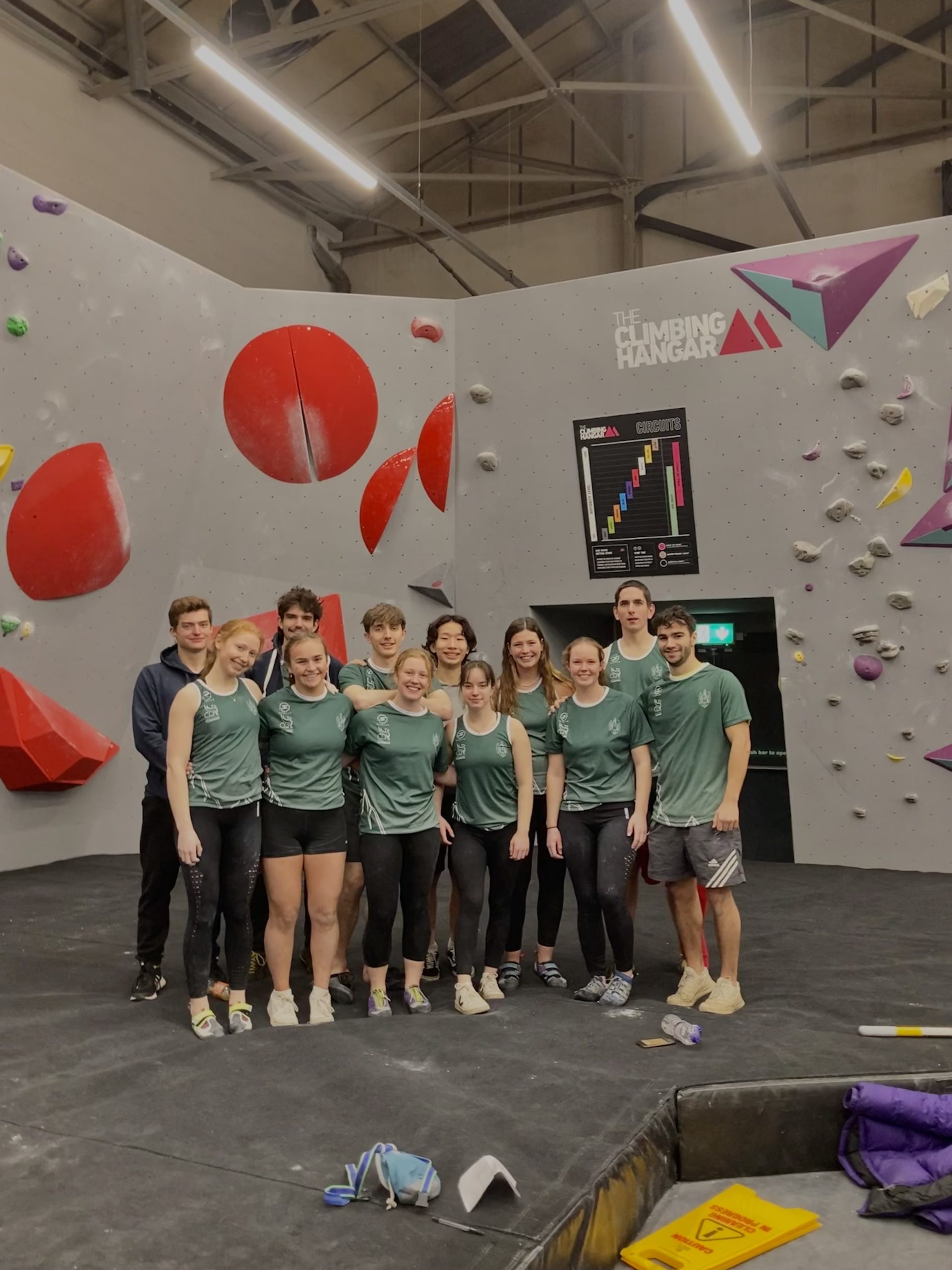
2 – Myself (second left) with the competition team at the third round of the Northern University Bouldering Series, of which one of our girls achieved 3rd overall.
3 – Training day of the CWI at The Big Depot, Leeds
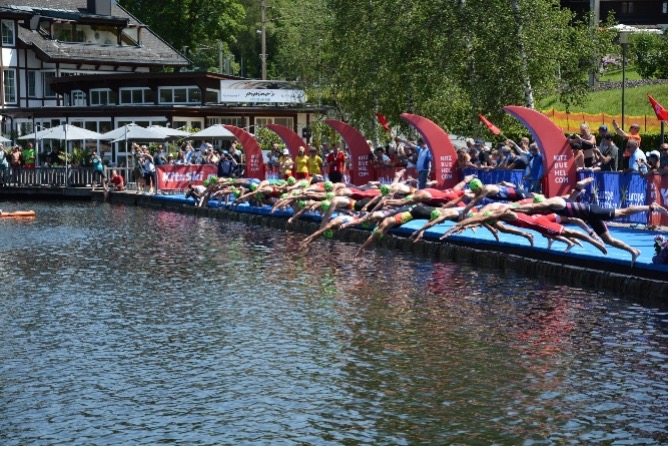
I travelled to Kitzbuhel on June 15th to compete in a European Cup Triathlon event, representing Great Britain and support from the Jack Bloor fund allowed me to fund my travel to the event. The race format was an eliminator- something that I hadn’t done before. Heats took place on the Friday, where the 10 first finishing athletes in each heat qualified to race the following day. Then, the top 30 athletes started the next day, when the format consisted of 3 shorter races. At the end of each, the bottom 10 athletes were eliminated from the competition, until there were 10 in the final race.
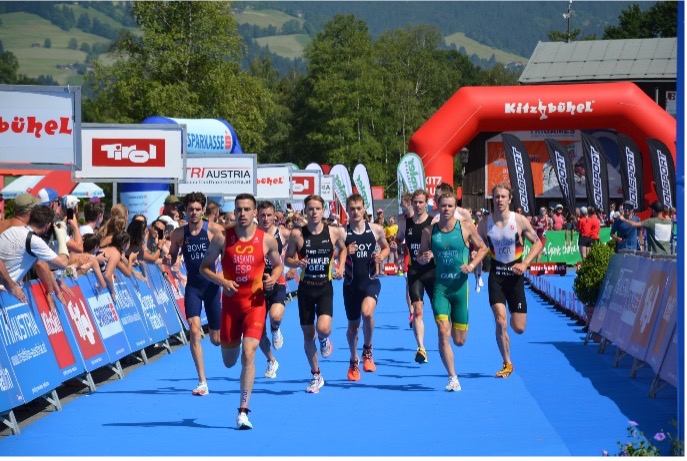
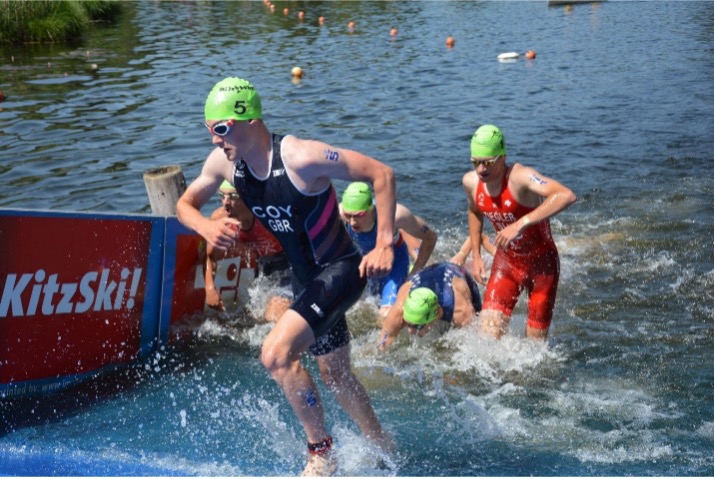
The racing was fast, hot, and tough, but I managed to get into the final race and finished 6th overall, my best senior result ever. Completing 4 races over 2 days provided many opportunities for me to practice race skills such as racing open water with close contact around buoys, transitions and more. The race location was amazing, and I had a great experience, plus, the result means my world ranking went up by over 100 positions, allowing me to get international racing opportunities more easily in the future. Thanks very much for the support, it has made a huge difference 🙂
Calum Sowden – Mountain Leader Assessment May 2022, Snowdonia, Wales
In May 2022 I attended my Mountain Leader Assessment in Snowdonia. This is a qualification which I have been working towards for the last couple of years, and I am incredibly appreciative of the support from the Jack Blood Fund.
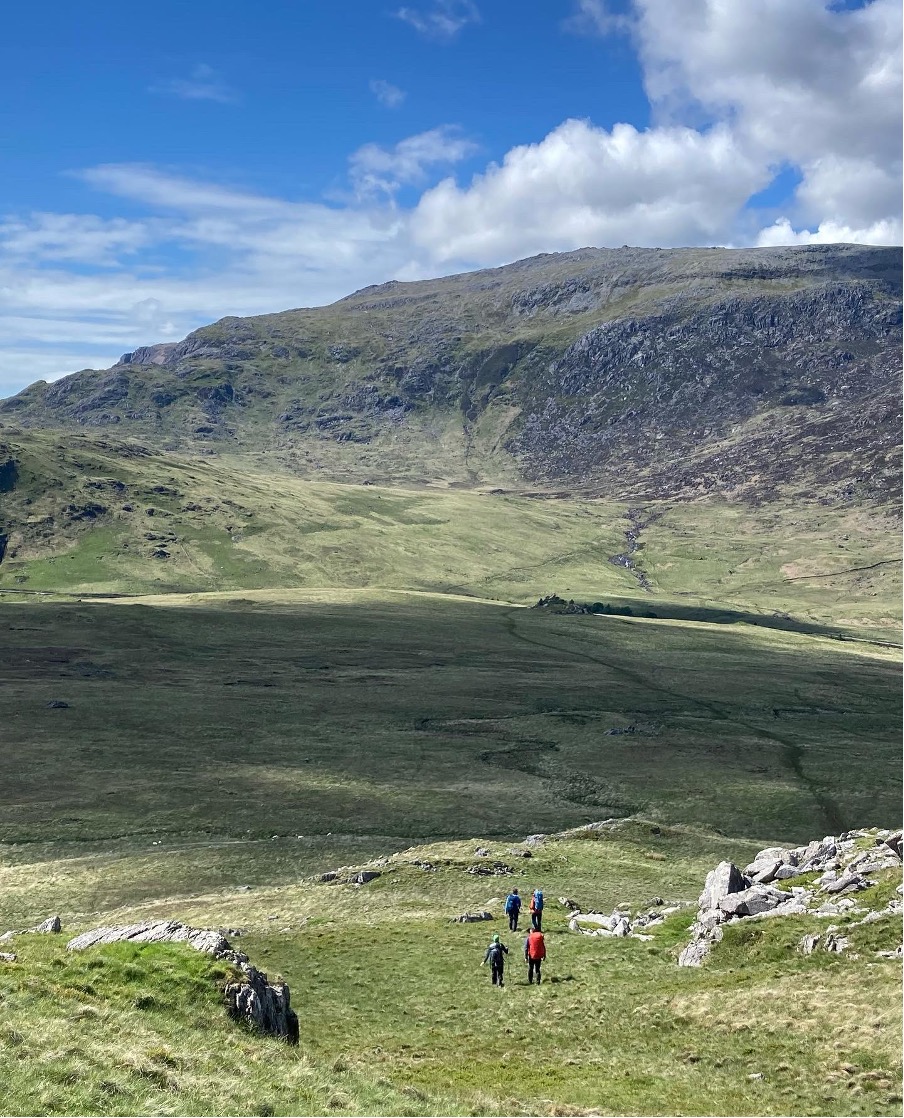
The five-day assessment kicked off with a day in the Crimpiau area of Snowdonia. We spent a full day on the hill, completing micro-navigation legs and discussing emergency and extrication procedures for group leaders. This was a good warm-up for the rest of the week, and an indication that the hard work I’d put in over the preceding months was going to pay off. The next day saw some pretty miserable weather coming in. Not the kind of day to be stood around, but that’s exactly what we did as we had all the emergency rope work skills and steep ground management to demonstrate. Despite an early hiccup when spotting the assessor on steep ground (which I rectified later on through a second chance) the day went really smoothly. The assessor chose me to manage the whole group on the only section which we actually needed the rope, rather than in artificial circumstances, which I took as a major indication of his trust in my ability.
Over the next three days we undertook the ‘expedition’ – a three-day, two-night trip with wild camps both nights. On the first day, we took in Snowdon via the Ranger path before dropping down into Cwm Tregalan for the camp. Once the sun had set, we set out on the night-navigation element of the assessment. This is the part which candidates are often most nervous for, however the is the component which I spent the most time practicing and so it went very smoothly. We did have perfect conditions for it, with 50m visibility, so there were no real excuses! On the second day we looped around towards Moel Siabod before cutting back to Pen y Pas and camping in Cwm Glas. The second round of night-navigation went just as well and at this point I was confident that the week had gone well. I spent the night camped on a little island in Llyn Glas, but woke to the stepping-stones completely submerged after a night of heavy rain! The final day was short and sweet and we made it back down to Llanberis for a big fry up in Pete’s Eats by midday.
All in all, I was really pleased with how the week went, and delighted that I passed the assessment. Thank you so much again for all the support, it’s really appreciated!
Organisers of the Jack Bloor Races are delighted to announce continued support from three generous local businesses in Ilkley.
Please give them your support. Thank you.
Terry Lonergan of Complete Runner is a long-standing sponsor of the Jack Bloor Races and has been a generous donor to the Jack Bloor Fund. Complete Runner is a specialist running shop on Leeds Road in Ilkley with online trading at http://www.completerunner.co.uk
Outside the Box will be supporting our Junior Races. This is Ilkley’s incredibly popular and successful community café. Outside the Box has recently relocated to new premises in the Victorian Arcade accessed from South Hawksworth Street near Ilkley’s central carpark. More details at http://www.outsidetheboxcafe.com
The Flying Duck Pub will be sponsoring our Senior Race. The Flying Duck is a traditional Yorkshire Dales real ale and fine wine bar situated close to the centre of Ilkley. Located in one of Ilkley’s oldest premises the atmospheric pub can be found on Church Street a short distance west of the central A65 traffic lights. This Grade II listed building is also home to the Wharfedale Brewery that supplies pubs the length of the dale. Further details at http://www.flyingduck.org.uk and http://www.wharfedalebrewery.com
Junior age categories based on age on 31st December 2022
Senior age categories based on age on day of race (including for U23)
Parental consent is required for all U18s including those in the Senior Race
This is a navigational fell race consequently the use of any electronic device to aid route finding is prohibited
In view of daylight runners should be capable of completing the course within 100 minutes. If necessary, Checkpoint 3 (Cowper’s Cross) is a suitable point from which to retire with an easy descent north down Keighley Gate track to Wells Road and Race HQ.
All senior competitors and consenting parents or legal guardians of junior competitors must read and comply with:
12 lucky winners will receive one of these unique trophies at the 2022 Senior Race.
This years trophy is called the Broken Pitchfork, which can be found east of the Badger Stone (which is checkpoint one, so keep your 👀 open in the race), grid reference 1150 4604
The Small Trophies have been presented at the Jack Bloor Races since 1985. Pat Bloor initiated the idea of using a rock carving from Ilkley Moor for the overall winners trophies and for the small trophies, which have become a unique feature of the race.
Every year we select a different stone carving and produce a small trophy which is presented to each class leader to keep.
Thanks to James Fonquernie for making the trophies every year since 2007.
Thank you so much for the very generous Jack Bloor award towards my costs to attend the British Championships in Germany, I really appreciate it. That’s such a nice surprise to come home to. I am a member of the British Biathlon Development Squad, with ambitions of being part of the Junior Squad so l can train and work towards a place in the team for the Olympics 2030. I train at the Brownlee Centre in Leeds with my coach Martin Roscoe.
The British Championships were unfortunately cancelled due to covid, (the website is www.awsa.org.uk). However we did compete in a local race instead. I got a podium finish in 3rd place in my first race. It was a 8.8km race consisting of 8 times round a 1.1km lap. Thankfully I got my breath back on the downhill parts. We also did a time trial race the day after where I finished in 2nd place which I was really pleased with.
The event took place in a small town in southern Germany called Ruhpolding. I trained on the World Cup biathlon track, which is called the Chiemgau Arena. It was great to see some biathletes who are heading out to the 2022 Olympics.
I have attached a picture of me on the podium and a few other photos which may be of interest.
After a mixed bag of results in 2021 I was pleased to be selected for Euromeeting. I think the lack of quality competition throughout 2020 and early 2021 affected everyone differently but I certainly lost some consistency in my performances. Euromeeting is a competition that is typically held two years before the world championships in the host country. It provides an opportunity to race in relevant terrain and to experience some high-quality international competition. Great Britain took a large team consisting of some experienced seniors and some older juniors who had been unable to race at the Junior World Champs in red-listed Turkey.
Despite some apprehension my flight departed without a hiccup. Upon arrival I fumbled with entry forms and proof of vaccination but to my relief I was briskly ushered through security and into Switzerland. The train journey from Geneva airport to Brig is beautiful. Starved of international travel, I made my way to the top tier of the train and found a large window from which to admire views across Lake Geneva and toward snowcapped alpine peaks. I also marveled at the locals who seamlessly transitioned from speaking French to Swiss German at some undefined point along the journey. When I reached the small valley-bottom town of Mörel I boarded a gondola which took me up the mountain slopes to the picturesque ski village of Riederalp. After finding our chalet accommodation, I went for a jog to stretch my legs and to check out the model map. After navigating to a few controls, I headed up to the closest peak the Riederhorn. I caught my breath in the still mountain air and watched as the sunset bathed the surrounding peaks in a pink glow. With only a solitary pair of Chamois for company I looked across to the Matterhorn in one direction and the Aletsch glacier in the other. Only the gathering darkness forced me back to our accommodation where I prepared my kit for Saturdays middle distance race.
After a 4km jog to the event centre in Bettmeralp I enjoyed the unique chair-lift approach to the starting area. On the ride up the hill we were able to look down on competitors zig zagging across the open ski-slopes and diving into pockets of dense woodland. Despite the high starting point our course still had over 300 meters climb in 5km. At over 2000m altitude I knew this would be a physically demanding course. I began cautiously and took my time to identify the obvious features and take the safest route choices. With this careful approach I managed to stay mistake free until I got caught on the wrong side of a large crag in the steep forest loop, I realized what had happened quickly and didn’t lose too much time here. The final few controls took us out of the forest and across the hillside to the finish. It was the most physically demanding section of the course and in my haste to avoid any extra meters of climb I contoured a little too much and had to fight through some thick dark green vegetation costing me another few seconds. Despite the two small lapses in concentration, I was pleased with my performance on a new and challenging terrain. The results list was tightly packed in the men’s race with only 6 minutes separating the top 60 runners. Most of the British runners packed tightly with 7 runners in a two-minute window from Pete Molloy in 61st place down to me in 77th. Hector Haines was the best male performer of the day in 25th and Grace Molloy the top female in 20th for Great Britain.
Sunday’s long-distance race was held high above the village of Bettmeralp with most of the race taking place on a complex rocky ridge over-looking the Aletsch Glacier. With rain forecast we had discussed the possibility of cloud making navigation tricky. The day started bright but as I waited to race, cloud descended and soon visibility was reduced to just a few meters. The cloud failed to lift for the duration of my race, but I loved every minute. The grassy alpine meadows between the rock and contour formations typically make for rapid running. However, with reduced visibility I had to maintain contact with the map at all times, moving from feature to feature. No sooner had I crossed the finished line, than the cloud began to clear and before long the entire area was cloud free. I knew this would spoil any chance of a top result but despite that I had loved my run and was pleased to make the top 50, finishing in 49th place. I’d like to think I ran one of the fastest times amongst the athletes who ran during the total cloud cover! I then headed back to our accommodation where I ate and packed up before heading to the Gondola and beginning my long journey home.
I had such a wonderful weekend and have rekindled the fire and desire to compete on the international stage. I was pleased with two stable performances and solid results in a stacked field. I will now look ahead to my next goal; the European Champs being held in Estonia in 2022. I would like to thank the Jack Bloor fund for providing financial support which made this trip possible.
Finally, I would like to acknowledge everything the Jack Bloor Fund has done for me since 2010. As I reach the end of 25 years of Jack Bloor Fund eligibility, I have taken some time to reflect (and dive into the fund archive) on all the wonderful trips that have defined my youth. Beginning with the Lagganlia training camp in 2010, aged 14, and ending in 2021 with Euromeeting, the Jack Bloor Fund has supported me for 11 years with a total of 8 grants for 7 international races and 1 training camp. The competitions included World Schools, European Youths, Junior European Cups, Junior Worlds, the World University Championships and Euromeeting. I have travelled to Italy, France, Portugal, Germany, Switzerland and Finland. The friends I have made are still my best mates at home and abroad and the memories are some of my fondest. It has not always been a smooth ride with several post-race reports detailing navigational errors and disappointing performances, however Jack Bloor’s support has been constant. These competitions have taught me resilience and instilled in me a desire to try hard in all aspects of my life. I cannot begin to express my gratitude to the trustees and to Jack himself. I will always endeavor to make it back home for the annual race (and to one day win it!) and hope to support the fund and Yorkshire’s next generation of outdoor enthusiasts when I finally finish studying and get a job! It has been such a privilege. Thank you.
Lagganlia 2010, World Schools 2011, EYOC 2012, World Schools 2013, JEC 2016, JWOC 2016, WUOC 2018, Euromeeting 2021. Top performances: 2 x 4th Place at the World Schools champs. 16th Long Distance, 21st Sprint at the European Youth Champs, 7th in the Relay at the World University Champs.
The view from team GB accommodation!The training area, Riederalp and the Aletsch Glacier11 years of competition, supported by the Jack Bloor Fund!






 Jack Bloor Race & Fund