Grace Black has Olympic ambitions, she races Canoe Slalom. At aged 15 she has been promoted to the Premier division following a weekend of racing at Holme Pierrepont in Nottingham. This means she now competes in the same division as Olympic and World Cup athletes. The Jack Bloor Fund helped her to compete in two races, in Prague and Bratislava.
Firstly I would like to thank you for the funding you so kindly granted to Grace for her trip to the ICF and Junior European cup races in Prague and Bratislava. Please find below a report and photos of her in action during the training and races.
Grace has her own Facebook page and she has shared and promoted your page on Grace Black Canoe Slalom Athlete.
I had a great time training and racing in Prague and Bratislava in the ICF and ECA races. I received some good training from the GB coaches Aaron, Matt and Alice and enjoyed every minute of the two weeks. I didn’t get the results I would have liked but gained valuable experience from competing in my first ICF races. As a result of taking part I now feel I am better equipped to take on these more difficult races and achieve better results in the future and move up through the international rankings.
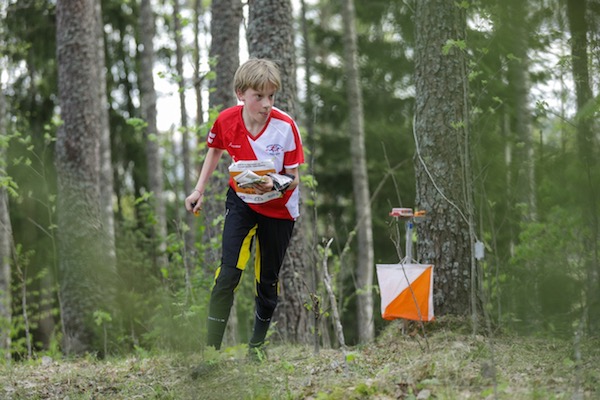
It was in the early hours of the morning when we began our vlog of WSOC 2019. This became the best documentary of our amazing time in Estonia and allowed us to relive all the funny moments. Following an early morning start, 2 flights and a long bus journey an excited team consisting of junior athletes from all over England arrived at Kääriku Spordikeskus accomodation where we would be staying alongside the Finnish, Austrian, Spanish and Beligian (Flanders) teams.
On the first day we travelled to the Arena in hot weather to enjoy a model training day whereby all athletes were allowed to head to the forest to get a feel for the terrain we would be running in for the competitions. Getting used to the vegetation and mapping style of the events, teams spent the day at the arena followed by the opening ceremony with a representative of each nation parading with their flag. This climaxed with he lighting of the torch, marking the start of the competition.
The long distance race was a tiring competition in the heat and sun, through difficult terrain. For me this involved a disappointing run due to large time loss at control 2 which I was unable to recover from. Nevertheless having finished the race me and a few other members of the England team took to a multicultural game of ultimate frisby with the Swedish and Australian teams.
After a tough day of racing we were rewarded with a rest day involving a visit to the Science Centre AHHAA in Tallinn. With plenty of time to enjoy the interactive displays we took this as an opportunity to get to know the other nations, forming particular friendships with the Slovakian team and getting to know our Finnish neighbours from our accommodation better. Soon enough we headed out into the city for an ‘orienteering game’ where we could explore the city whilst completing a quiz. By this point in the week the weather had turned to heavy rain resulting in a team of very wet and hungry orienteers by the end of our walk around the city! Once we had reconvened in the sports hall however our mood was quickly heightened with the prospects of the nation’s night. Here every country had a stand to offer examples of their native country’s cultural specialities and (ofcourse) some maps of their home terrain. This was exciting as everyone mixed, trying out different foods (crowds gathering around the Spanish churros stand) and exchanging bracelets charms and ribbons. As the evening approached it was time to display our patriotism with the traditional morris dancing. A dance that’s trickier than it seems as we tried not to hit each others fingers with our sticks! Particular highlights of the night were the countries where we were called up to join them on the dance floor having watched their traditional native dance.
The next day having formed many friendships already we were back to racing in the middle distance race. This was a fast paced race which suited me well. Unfortunately however I made a 4 minute mistake halfway round the course which was particularly frustrating for me as I found I was only 2 minutes behind the leader. This landed me in 12th position over all. That afternoon, having been adamant to go swimming since day 1 we headed out to the lake at our accomodation. Ofcourse by this point the weather was no longer ideal swimming weather as the temperatures had dropped from the 20+ degrees from the early week to 1°C. With our excuse of ‘its an ice bath’ this didn’t matter to us and we jumped into the lake with (almost) no hesitation. With the Finnish and Australians joining us at the lakeside -but not wanting to join us in the water- it was all laughs when the snow began falling!
Our final day of racing was the friendship relay where we were put into groups of three with individuals of difference ages and different nationalities. For me this meant I was paired with a younger boy from Poland and a girl my age from Slovakia. This event is like a team score event however all members of the team must pass certain check points together at the same time. This was incredibly chaotic but also fun as everyone ran round the town working together to finish as a team.
On the return to the accomodation we were better prepared for the cold weather and booked a sauna to enjoy after our jump into the lake. This was followed by the final team prize giving where we were able to cheer on the Select boys for their winning team effort. The closing ceremony was a great display of Estonian dancers and this ended with the last night party with a live singer (number one in Estonia) playing.
An incredible end to a fantastic week. I think everyone would agree it was truly unforgettable! It seemed by the end of the week almost all the nations new about the ‘England team vlog’- a hilarious collection of videos that I still rewatch now! I made the best friends at WSOC and can’t wait to see them again at EYOC:)
Thanks to help of the Jack Bloor Fund
Anika orienteering
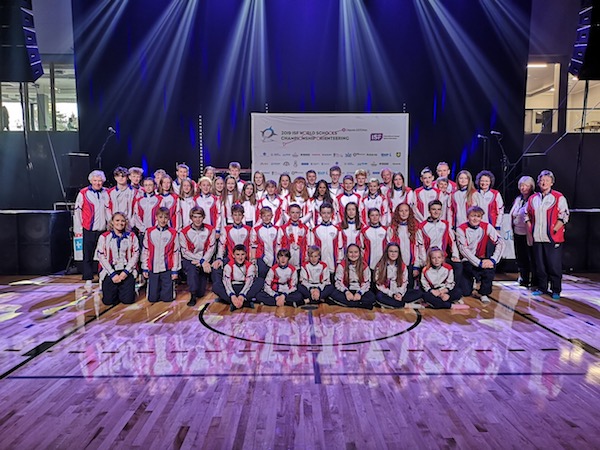
England team
World Schools athletes
Held in Zermatt, Switzerland, the 2019 European Mountain Running Championships excelled in all aspects. After nine months of injury and rehab, including a broken foot only two months before the race, I was extremely grateful to have been selected by British Athletics after proving my fitness. The course was a suitably challenging yet exciting route, gradually increasing in gradient and altitude.
After working hard to get a strong start before the track narrowed and the technical ascent up to 2,600m of altitude began, I was able to slot in with a small group chasing the leading trio. With a lot of runnable track, the pace was fast and the final climbs certainly got both my lungs and legs burning. Crossing the line in 12th position, I was delighted. I must give much credit to my coach, Andy Henderson, for getting me fit enough to compete in such a short time period (and for coaching Euan Brennan to an amazing 5th position in the U20 men’s race)!
Team spirits were flying high for Great Britain as Joe Dugdale and Jacob Adkin brought home individual golds, leading their respective teams to gold medals too (U20 men; Senior men). In addition to a great weekend of racing, this experience provided a great opportunity to learn and develop skills which will undoubtedly help future performances. The Jack Bloor Foundation greatly facilitated my training for this race, which I hugely appreciate.
Euan Brennan and myself in front of the Matterhorn after the race.
At the end of April, 12 Juniors from SYO jetted off to Estonia to compete as part of the 40-strong England Team at the World Schools Orienteering Championships 2019. The week-long event was based at the Tehvandi Sports Centre close to Otepää in the South-East of the country, with the arena for all days at the Athletics Stadium – complete with run-in along the track! The forests we were running in were adjacent to the sports centre, and all the races had a few final controls amongst the ski slopes and jumps.
Live TV coverage and results were available for all of the races, so supporters could watch back home as we competed. There was even coverage of the Opening Ceremony, complete with a drone to catch the action from overhead. Check out this aftermovie to see some of the highlights from the week!
Below are reports by the Select SYO runners (7 SYO members were individuals in Select teams, whilst 5 boys made up the High Storrs Schools Team)…
Model Event – Tuesday 30th April (Dom D) Before travelling to Estonia, all the team were able to look at maps online (map-geeking), but it was difficult to judge what the areas for the races would be like, with the biggest unknown being the vegetation, and how it was mapped. The day before the official races began, we had the opportunity to check out the terrain in a specially organised Model Event. As well as a chance to run on very similar terrain, we could also see how things such as the start and finish would be set up. We went round the ‘score’ style course both in groups and individually, allowing us to meet up with our coaches to discuss what we found along the way, which helped us to develop our plans for the Long and Middle. We quickly realised the importance of avoiding even “light green” forest due to its density, and this was the main point we took away to bear in mind for the following days. There was a real mix of vegetation with coniferous and deciduous forest – some incredibly runnable, and other parts, such as the marshes, less so! For some members of the team these were the first controls they’d ever found abroad, and it was to be the start of what was a great week of orienteering and memory-making!
Opening Ceremony – Tuesday 30th April (Alex E) After the model event it was time for us to relax and enjoy the opening ceremony in the sunshine that we would soon start to miss over the following days. The event began with the procession of flags from each nation, followed by a series of traditional Estonian dances representing unity and friendship. We then had some brief speeches from the Presidents of Estonian school sports and IOF, and the deputy president of ISF, as well as the oaths of fair play for the athletes and coaches. Last but not least was the ceremonial lighting of the flame: an Estonian athlete strode along with the torch – followed by an entourage of dancers – to officially begin the competition.
Long Race – Wednesday 1st May (Alex C) After months of excitement, preparation and waiting, I was finally at the start line of the long distance race – my first run at the World Schools Championships 2019. After the previous day’s training on similar areas, I had already got a feel for the terrain and the map although, as prepared as I was, I was very nervous. The course started straight up a huge hill, which was both a technical and physical challenge but I navigated well and managed to keep running (pretty much) all the way to the top. The rest of the course went pretty smoothly and I made few mistakes, the terrain wasn’t very runnable but I really enjoyed my course. Running into the arena was an amazing experience and nothing like anything I’d ever done before, with live coverage of the whole event and an amazing atmosphere.
Cultural Day – Thursday 2nd May (Imogen P) The cultural day was extremely exciting, it first involved a trip to the Tartu Science Museum which was amazing. We spent 4 hours in the museum going on the various interactive attractions including a spinning tunnel, various water exhibitions (which involved us getting quite wet!) and riding on a bike suspended in the air. After this it was time for a very wet but fun orienteering quiz course around the city of Tartu where we were sent out in groups of 10 to find various checkpoints around the town and answer a question at each one. Eventually this led us to the University which was where the cultural day celebrations took place later that day. The cultural evening certainly exceeded our expectations with every country performing their own national dance or song. My personal favourite was the Austrians at the start because we all ran down to join in at the end. England performed Morris dancing which was very hard and took me a while to learn but was definitely worth it and we got to dress up in costumes with England hats and tattoos. In addition every country provided a stall with different foods or items from their country. (The New Zealand sweets were really good!) All in all it was a very good day and I had a great time!
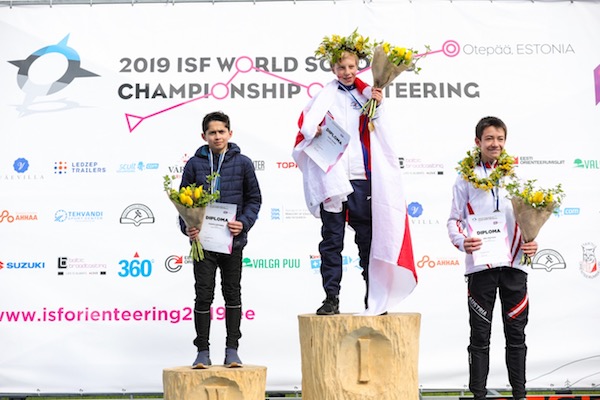
Middle Race – Friday 3rd May (Max M) On Friday, the Middle Distance took place. Unfortunately, the weather changed dramatically from 21 degrees on the Long to 2 degrees and snow for the Middle. Luckily the quarantine was indoors. The wood was filled with small paths crisscrossing between small hills. It was really enjoyable but needed concentration. I had a great run coming in 1st after around half the competitors! After a nice risotto for lunch, I just had to wait to see how I had done. Amazingly I came 6th – which is on the podium. England also had 3 more podiums with Euan winning M2 School, Jim taking 5th on M1 Select and Flurry taking a 2nd on M1 select. Overall it was a great day for the English team! And as we were all tired, the rest of the day was spent relaxing.
Friendship Relay – Saturday 4th May (Sam C) On Friendship Relay day we, as normal got up and got breakfast, then went to the event arena. England arrived early and we watched the rest of the teams slowly arrive. The teams of three, each from a different country begin to assemble. At 11 the maps were given out and despite language barriers teams had to decide the route they would take each. I had an Estonian and a Russian on my team and it was hard to sort out who was going where but after a while we managed. Next was the start. There was a giant pen and after 15 minutes the tape was dropped and everyone started running. Once everyone started and got all the close controls teams had to meet up at point A which was on a large hill. The same happened from point A to B and B to C. On the run-in everyone had to hold hands and afterwards there was the traditional swapping of kit as there are no more races. I managed to get the highly prized New Zealand top, a Polish top and a Spanish top too. It was a great day I will always remember.
Closing Ceremony – Saturday 4th May (Dom D) Sadly, all good things come to an end, and so following the inter-country top swapping we headed back to our accommodation to get ready for the closing ceremony… and farewell party! The other members of my team had put in some fantastic runs in the Long and Middle Races, placing our M1 Select team 1st overall. The overall prizegiving was incorporated into the closing ceremony, along with the expected speeches, and a slightly less traditional performance by a dance troop, including one where the dancers portrayed a snooker game! Alas, it was the end of World Schools 2019 – but there was just time for the Farewell Party – complete with a live Estonian singer and band, who performed a mix of originals and covers (thankfully!)
A huge amount effort was put into the World Schools Orienteering Championships 2019 – complete with Opening and Closing Ceremonies, and live results and streaming to those back home – and so we’d like to thank the organisers for putting on such a great event, and our England team managers for making it all happen.
Equally our thanks go to the Jack Bloor Fund, Yorkshire and Humberside Orienteering Association, and SYO for their financial support.
Overall a fantastic experience, making memories that will last a lifetime!
Junior age categories based on age on 31st December 2019
Senior age categories based on age on day of race (including for U23)
NEW:
The U19 class race will start at 6.20 pm along with the U13 and U15 classes
Parental consent is required for all U18s including those in the Senior Race
This is a navigational fell race consequently the use of any electronic device to aid route finding is prohibited
In view of daylight runners should be capable of completing the course within 100 minutes. If necessary, Checkpoint 3 (Cowper’s Cross) is a suitable point from which to retire with an easy descent north down Keighley Gate track to Wells Road and Race HQ.
All senior competitors and consenting parents or legal guardians of junior competitors must read, familiarise and comply with:
This years trophy is called the Winners Stone, which can be found on Stanbury Hill near Fenny Shaw Beck, grid reference 1097 4338
The Small Trophies have been presented at the Jack Bloor Races since 1985. Pat Bloor initiated the idea of using a rock carving from Ilkley Moor for the overall winners trophies and for the small trophies, which have become a unique feature of the race.
Every year we select a different stone carving and produce a small trophy which is presented to each class leader to keep.
Thanks to James Fonquernie for making the trophies every year since 2007.
Organisers of the Jack Bloor Races are delighted to announce continued support from three generous local businesses in Ilkley.
Please give them your support. Thank you.
Terry Lonergan of Complete Runner is a long-standing sponsor of the Jack Bloor Races and has been a generous donor to the Jack Bloor Fund. Complete Runner is a specialist running shop on Leeds Road in Ilkley with online trading at http://www.completerunner.co.uk
Outside the Box will be supporting our popular Junior Races. This is Ilkley’s incredibly popular and successful community café. Outside the Box is located in Bridge Lane at the junction with the A65, Church Street. The café is opposite the Box Tree Restaurant and close to the Riverside Gardens park. More details at http://www.outsidetheboxcafe.com
The Flying Duck Pub will be sponsoring our Senior Race. The Flying Duck is a traditional Yorkshire Dales real ale and fine wine bar situated close to the centre of Ilkley. Located in one of Ilkley’s oldest premises the atmospheric pub can be found on Church Street a short distance west of the central A65 traffic lights. This Grade II listed building is also home to the Wharfedale Brewery that supplies pubs the length of the dale. Further details at http://www.flyingduck.org.uk and http://www.wharfedalebrewery.com
The trustees of the Jack Bloor Memorial Fund look forward to welcoming you all, juniors and seniors, to the 34th Jack Bloor Races on 14th May 2019, a Tuesday evening.
You may be wondering whether the race route has been affected by the devastating moorland fire that raged on Ilkley Moor on Easter Sunday.
The fire has had a major impact on the area between White Wells, The Lower Tarn, Blackstone Beck and Rocky Valley. However, the route of the JBRaces have been spared – just. The burnt area extends right up to the main track where the rough steps meet the west end of Rocky Valley.
Junior courses are entirely unaffected.
The vast majority of senior runners descend the steps, then follow the main track towards White Wells before dropping to the upper tarn and Checkpoint 6 (small summit). This route is entirely unaffected.
The small number of runners who depart the steps earlier and descend steeply over rough ground towards this last checkpoint would cross some burnt area. We request that this option be avoided in 2019 to minimise erosion of the fragile terrain. Thank you.
Thanks to the Jack Bloor Fund which helped me compete in the 2018/19 U23 World Cup series where l finished 8thoverall including a 3rdplace at Hoogerheide and 4that Koksijde.
My big goal for the season was the World Championships which was held on the coast in Bogense, Denmark. I gained selection with a 2ndplace in the Elite National Championships, 1stplace went to Tom Pidcock who became U23 World Champion.
After the national championships in January I went on a training camp for 10 days with my team (Corendon Circus) in Spain to prepare for the worlds and last races of the season. We did a lot of good quality training and coming into Hoogerheide (the last World Cup) I was feeling tired due to the amount of training and travel, but managed to finish 3rd and was very close to the second.
Coming into the worlds I was feeling good and with the result at the last World Cup I had a lot of confidence, I had a good start and was in the front group the whole race, unfortunately I had a puncture with 3 laps to go which meant I lost a few places but managed to get 6th in the end which I am happy with and now looking forward to the final few races left of the season.





 Jack Bloor Race & Fund